Learn More About Stationary Concrete Pumps
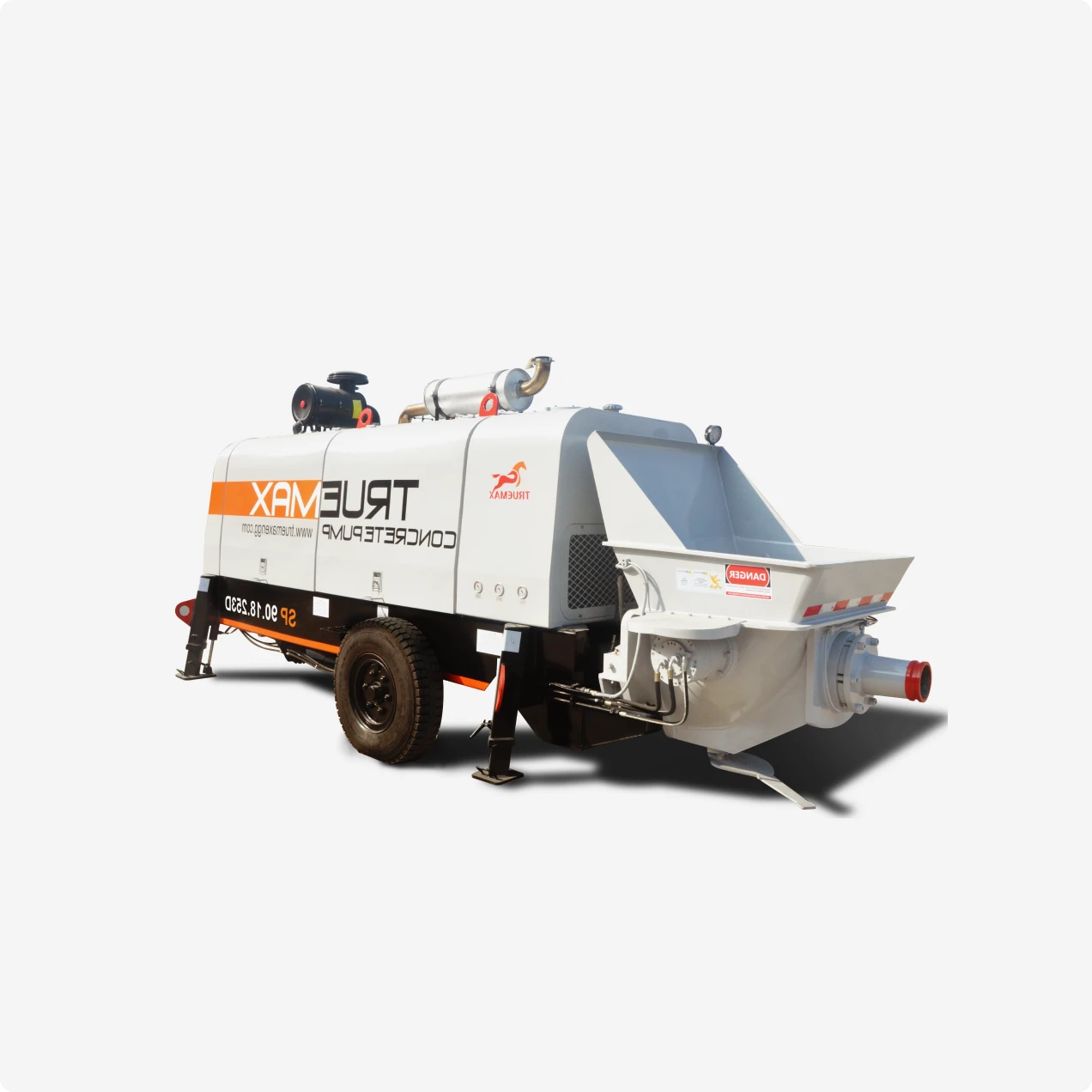
A stationary concrete pump — also called a trailer concrete pump, trailer-mounted concrete pump or concrete trailer pump, and known in North America and Australia as a ground pump, static concrete pump or tow-behind concrete pump — is a self-contained pumping unit on a towable frame that pushes concrete through a pipeline rather than a boom. Because it has no boom, it is sometimes searched as a concrete pump without boom; in the Philippines and parts of Southeast Asia the same machine is called a pumpcrete. The unit is towed to site, set up at a fixed point, and connected to a line of steel pipe and rubber hose; the working assembly is then a "line pump." TRUEMAX builds the A9 range as a diesel concrete pump — written diesel concrete pump machine in South Asia and Africa — on the same S-valve pumping principle used by established trailer-pump brands such as Putzmeister, Schwing and Sany.
The pumping unit and where its output comes from
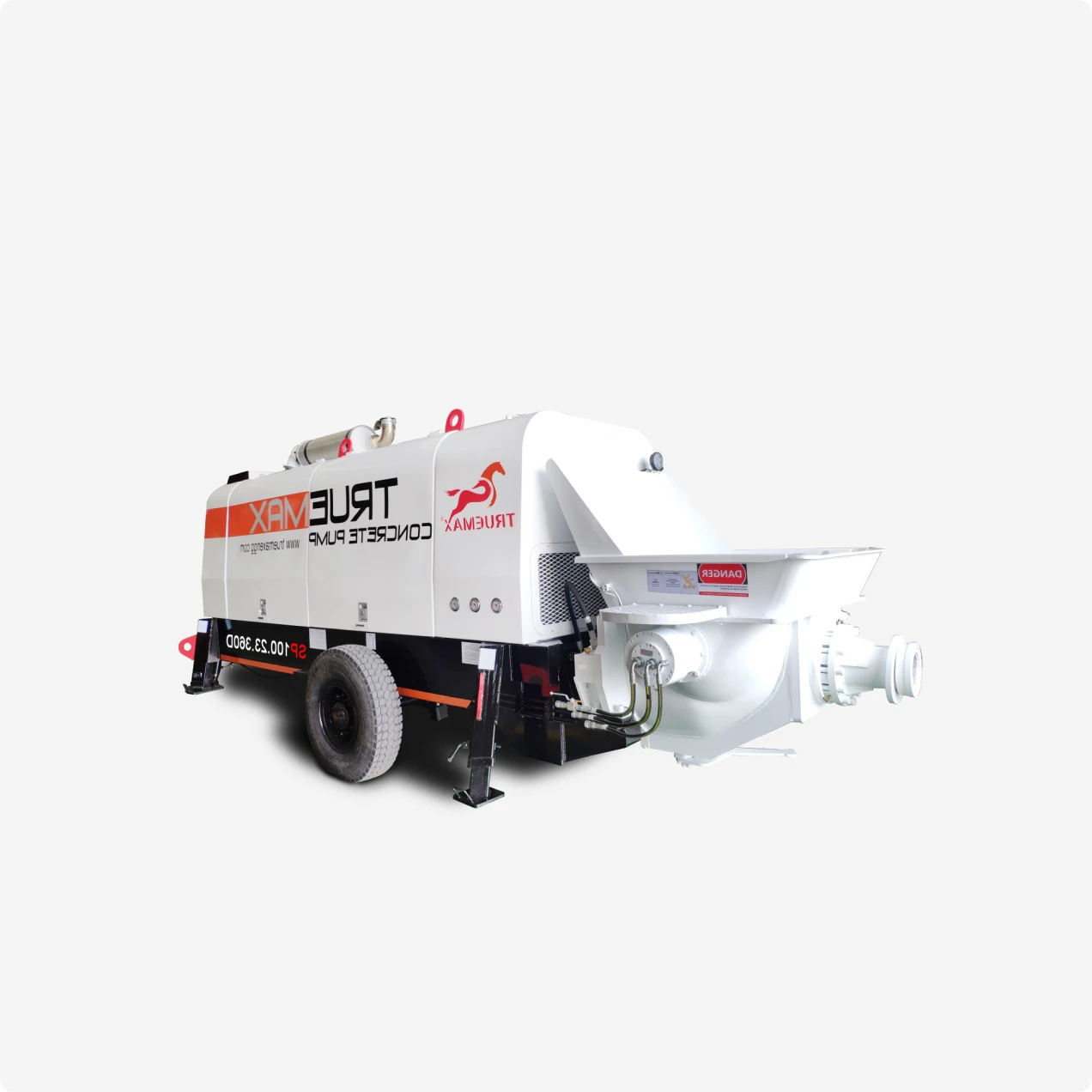
The pump is a twin-cylinder, positive-displacement, hydraulic stationary concrete pump — the machine some markets simply call a concrete pump machine, or a concrete pumping machine in the UK and Australia. Two concrete cylinders alternate: one draws concrete from the hopper while the other pushes its charge through the S-valve into the delivery line. Concrete pressure equals hydraulic pressure multiplied by the ratio of hydraulic-piston to concrete-piston area, so a smaller concrete cylinder develops higher pressure at the same hydraulic input — the reason the high pressure concrete pump in the range, the SP100.23.360D, reaches 23 MPa. Output, by contrast, is set by bore and stroke rate: a larger cylinder or faster stroking moves more concrete. The low/high gearing on each model lets the operator trade one for the other — high output at lower pressure for ground work, lower output at higher pressure to reach height.
Pipeline engineering is half the job
A stationary pump only performs as well as the line attached to it. Delivery pipe is specified by diameter — typically DN 125 or DN 150 — and by wall thickness, which sets its pressure rating; a 23 MPa pump must run pipe, clamps and gaskets rated above its working pressure, or the line, not the pump, becomes the limit. Pressure is lost to wall friction along every metre and to each bend, reducer and length of hose, which is why reach is estimated with Equivalent Horizontal Pumping Distance rather than read off the pump alone. On a riser, the vertical line must be clamped and anchored to the structure to carry its own weight and the reaction from each stroke, and a horizontal lead-in at the base smooths the pulsation before the climb. Minimising bends, using long-radius bends, and stepping diameters down gradually all cut the pressure the pump has to overcome.
Vertical pumping and high-rise work
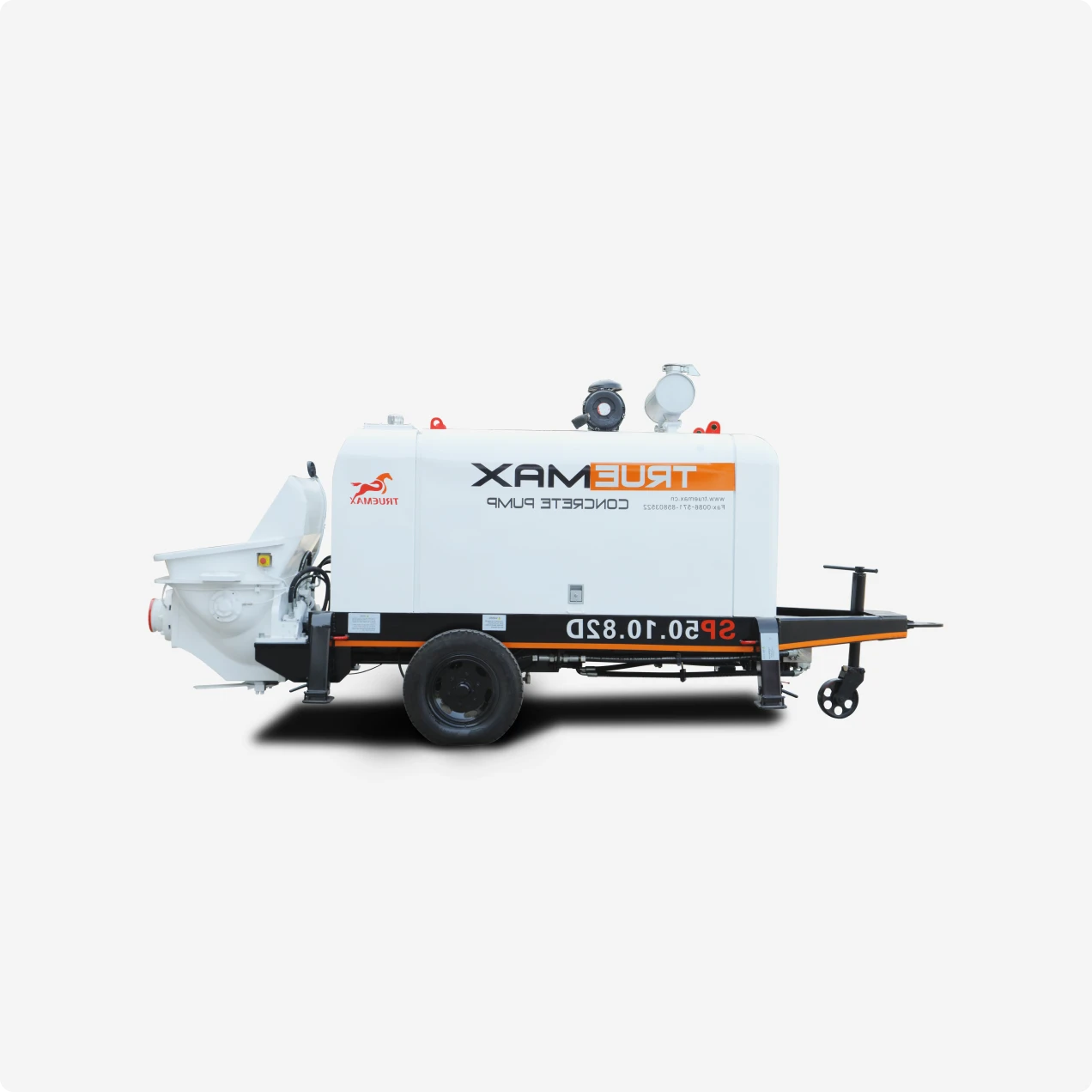
For a concrete pump for high rise building work, pressure — not output — is the constraint. Concrete needs roughly 1 bar for every 10 m of lift before friction is added, so a 200 m riser alone consumes about 20 bar before line resistance is counted; this is why genuine high-rise pumping is specified around the 23 MPa class. The S-valve seals under that pressure and holds the column between strokes so the concrete does not slump back down the riser. Pipe, couplings and the anchoring system must all be rated to match, and a blow-out at height is a safety event, not just a delay — which is why high-pressure lines are pressure-tested and inspected as a system, not part by part. For a concrete pump for bridge construction or road construction, where lift is limited, output and mobility matter more than peak pressure, and a smaller small concrete pump such as the SP50 is usually the right tool.
Priming, blockages and washout
Operating practice protects both the concrete and the machine. The line is primed first with cement slurry or a priming grout so concrete does not run dry against bare steel and jam, and air pockets are purged before full output. A blockage is cleared by reversing the pump to draw the plug back toward the hopper rather than forcing it forward. At the end of a pour the line is washed out — usually with a sponge ball driven through by water or air — and the hopper, S-tube and water box are cleaned before concrete sets. Treating the cutting ring, glass (spectacle) plate and chrome-plated cylinders as planned consumables, checked against pumped volume, is what keeps a pump sealing and holding pressure over a long service life.
Diesel, electric and control
The A9 series is diesel-driven and air-cooled, so it runs independently of site electricity — the practical default for remote sites and unreliable grids. Where mains power is available and noise or emissions are restricted, some buyers instead look for an electric stationary pump; engine, power and emission level are configurable to the market. The intelligent control system supports self-diagnosis, data logging and remote diagnostics, so an automated stationary concrete pump can be monitored and have faults read without a site visit, and remote control and remote monitoring options extend the same idea to operation.
Specifying and sourcing
When requesting concrete pump specifications from a stationary concrete pump manufacturer or supplier, the figures that fix the model are: required output in m³/h, pumping distance and height, the number of bends, concrete grade and maximum aggregate size, and the emission standard for your market. As a manufacturer building in-house at Haining, TRUEMAX supplies the pumping unit, advises on pipeline and wear-part planning, and ships to over 120 countries. Send your layout and we will confirm the model and line.