search
Search

Enter keywords to search for products, blog posts, and more.

Truck-Mounted Line Pump

Truck-Mounted Line Pump

Concrete Line Pumps That Drive Themselves Between Jobs

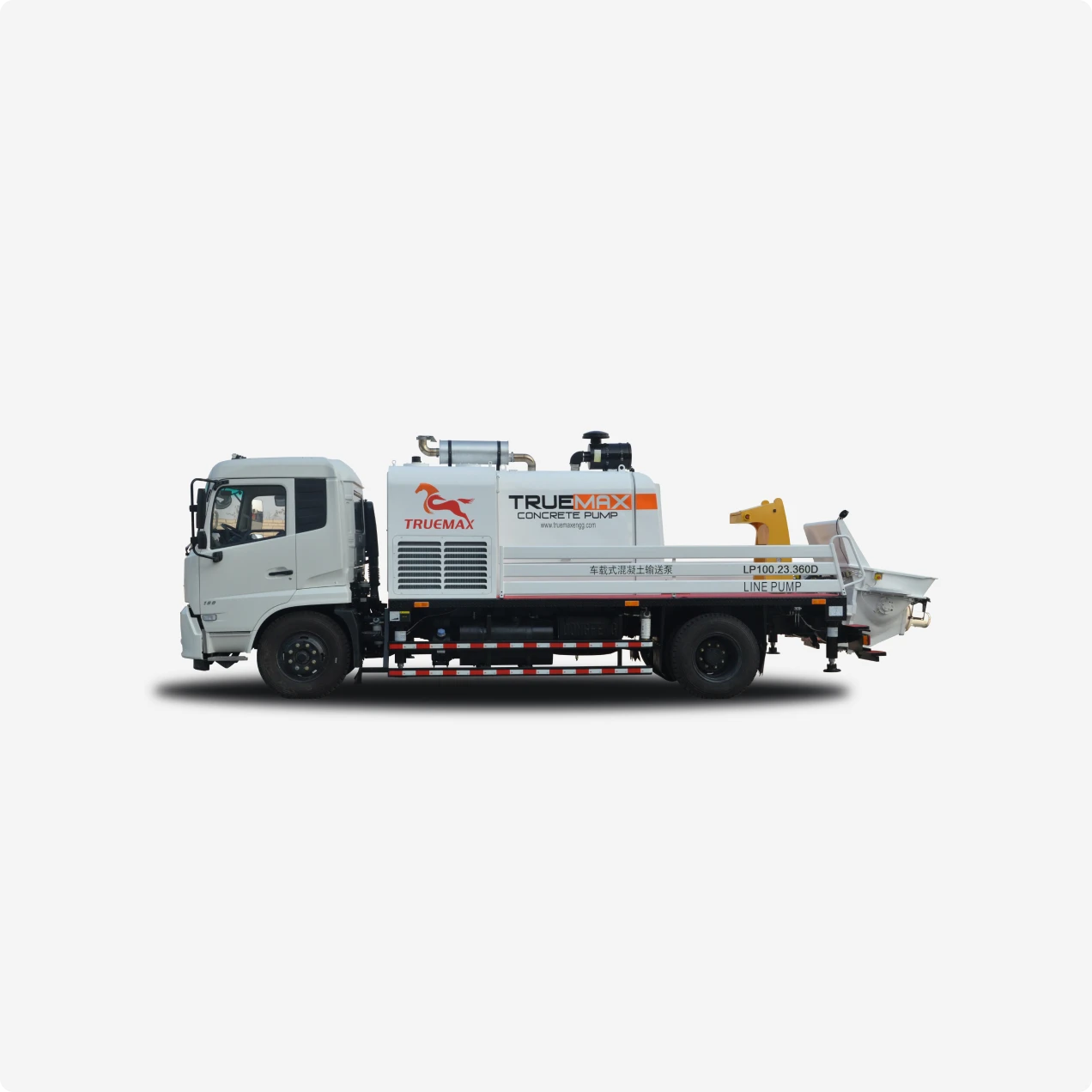
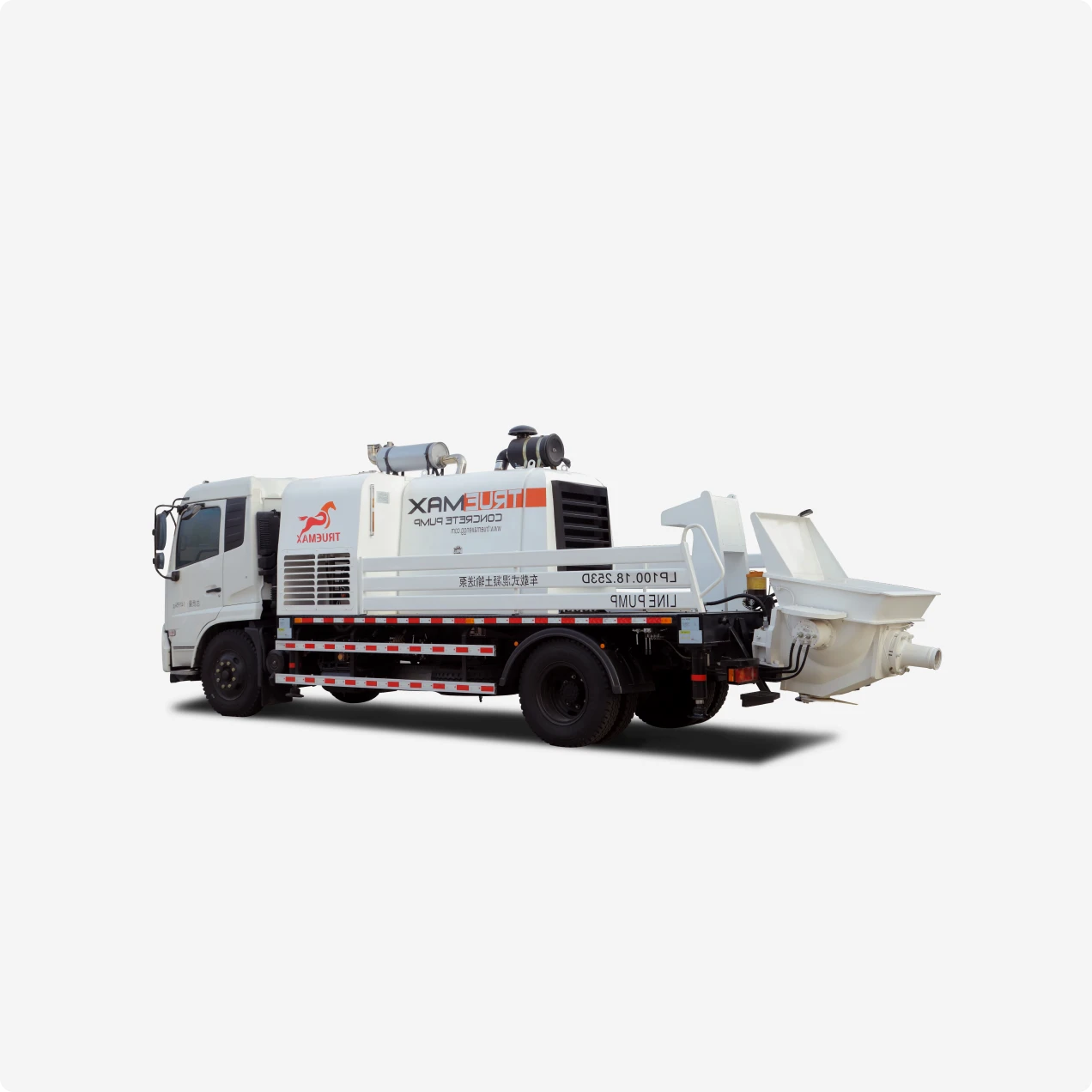
A concrete line pump moves concrete through a pipeline of steel pipe and rubber hose instead of an articulating boom. TRUEMAX builds the line pump in two formats — a towed trailer unit (our stationary pump) and the truck-mounted version on this page. The truck-mounted line pump puts the same S-valve pumping unit on a road-legal chassis, so it drives itself from job to job under its own power. In the industry this is known as a “city pump,” because its compact footprint and self-mobility make it the practical choice for congested urban sites, tight access, and contractors running several pours in a day. The LP100 series mounts on a Dongfeng or Sinotruk 4×2 chassis with a DN 150 outlet and an S-valve distribution system. Two models cover the range: the LP100.18.253D, tuned for output on horizontal and slab work, and the LP100.23.360D, tuned for pressure on longer and higher pushes. Both pump up to 100 m³/h — at the high end of what line pumps deliver — and both are built and tested at our own factory in Haining, China. With no boom to extend, reach comes from pump pressure and the pipeline you lay, which is why a line pump can run concrete farther across the ground, and into spots a boom truck cannot set up near, than its reach figures alone suggest.

Products in This Series

Concrete Line Pump Specifications

Full comparison of the two truck-mounted line pump models. Note the deliberate bore-versus-pressure trade-off: the 18 MPa model uses a larger cylinder for volume, while the 23 MPa model uses a smaller cylinder to develop higher pressure for distance and height.

SpecificationLP100.18.253DLP100.23.360D
Max. Theoretical Output — Low / High (m³/h)100 / 55100 / 53
Max. Concrete Pressure — Low / High (MPa)9 / 1811.6 / 23
Distribution ValveS ValveS Valve
Concrete Cylinder (Bore × Stroke, mm)Φ230 × 1800Φ200 × 1800
Outlet DiameterDN 150DN 150
Hopper (Capacity × Feeding Height)0.6 m³ × 14600.6 m³ × 1460
Main Oil PumpRexrothRexroth
EngineDeutzCummins
Rated Power (HP)253360
Rated Speed (r/min)21002100
Hydraulic CircuitOpen CircuitOpen Circuit
CoolingAir CoolingAir Cooling
Chassis BrandDongfeng / SinotrukDongfeng / Sinotruk
Axles4 × 24 × 2
Overall Dimensions (L×W×H, mm)9200×2480×32709730×2470×3570
Total Weight (kg)1380014540
Typical ApplicationMid- to high-rise, slabs, long horizontal runsMid- to high-rise, longer / higher pushes


How We Build Our Line Pumps

Every TRUEMAX line pump is built around an S-valve and twin concrete cylinders. On the intake stroke, one cylinder draws concrete from the hopper; on the output stroke, the S-tube swings across and pushes the charge into the DN 150 delivery line while the second cylinder refills. This positive-displacement cycle is what lets the pump hold pressure over a long pipeline rather than losing it to pulsation — the core reason a line pump can run concrete hundreds of metres across a site.

The delivery cylinders are chrome-plated on the inner wall for a service life of over 100,000 m³. The cutting ring and glass (spectacle) plate, which take the most wear at the valve, are made from rigid alloy by a dedicated process and treated as planned consumables. The hopper and mixing shaft are shaped for small mixing dead angles and strong suction, so the pump fills cleanly and handles a wide mix window from C15 to C70.


Hydraulic and Control Systems

The hydraulic side runs on an open circuit with a hydraulic integration block — a compact valve manifold that shortens oil passages, lowers internal flow resistance, and keeps system temperature stable. A one-button high/low-pressure switch lets the operator trade output for pressure when pumping farther or higher, and one-button twin-piston return drives both pistons into the water box for fast cylinder and wear-part changes. A dual-drive lubrication system, combining manual and fully enclosed automatic relubrication, keeps the moving parts greased and extends service life.

The intelligent control system monitors the engine and hydraulics in real time, runs self-diagnosis to cut troubleshooting time, logs running hours and fuel use, and shuts the pump down automatically on overload or low fuel to protect the engine and main oil pump. Remote diagnostics through the onboard system let faults be read without a site visit.


Built on a Road-Legal Chassis for Real Mobility

The mobility is the point. Mounted on a Dongfeng or Sinotruk 4×2 chassis, the LP100 drives itself to site and on to the next job without a separate tow vehicle or low-loader — the practical difference between a truck-mounted line pump and a towed trailer pump. Its compact footprint sets up in confined yards, narrow streets and congested city-centre sites where a large boom truck cannot deploy outriggers, which is exactly why the format is known as a city pump.

Power is diesel and air-cooled — Deutz on the 18 MPa model, Cummins on the 23 MPa model — so the pump is independent of site electricity. An energy-matching control aligns engine speed with pumping load instead of holding a fixed throttle; TRUEMAX rates this at up to 15% higher pumping efficiency and up to 10% lower fuel consumption against fixed-speed operation. Chassis brand, engine and emission level can be specified to suit local road registration and fuel quality.

Why Contractors Choose TRUEMAX Line Pumps

We manufacture, deliver, and support your equipment — from our factory floor to your jobsite, with local teams standing behind every unit we sell.

Factory-Direct Pricing

Factory-Direct Pricing

Customized Configuration

Customized Configuration

Proven Project Track Record

Proven Project Track Record

On-Site Installation & Training

On-Site Installation & Training

24-Hour After-Sales Response

24-Hour After-Sales Response

Global Spare Parts Supply

Global Spare Parts Supply

About Truemax

Established in 2003, Truemax is a concrete and construction equipment manufacturer with its own factory in Haining, China and over 10 overseas offices. We supply equipment, spare parts, and on-site service to contractors in more than 120 countries.

About Us Projects Solutions Facility

FAQs

What is the difference between a concrete line pump and a boom pump?

A boom pump carries an articulating arm on a truck and places concrete directly through that arm — fast to set up and ideal for open, high-volume pours and reaching over obstacles. A line pump has no boom: it pushes concrete through a pipeline of pipe and hose that the crew lays out across the ground or up a riser. A line pump costs less, fits into tight access, and can run concrete a long way horizontally, but it is slower to set up and place than a boom and better suited to smaller, longer-distance or confined-site work.

What is the difference between a truck-mounted line pump and a trailer (stationary) pump?

They use the same pumping unit; the difference is how it moves. A trailer or stationary pump is towed to site behind another vehicle. A truck-mounted line pump is built on its own road-legal chassis and drives itself between jobs, which is faster for contractors running multiple pours a day. Both pump through a pipeline, not a boom.

What is a city pump?

"City pump" is the common name for a truck-mounted line pump. The compact footprint and self-mobility let it work congested urban sites, narrow streets and confined yards where a large boom truck cannot deploy — hence the name. The TRUEMAX LP100 series is a city pump.

How far can a TRUEMAX line pump push concrete?

Reach comes from pump pressure, mix design, pipeline diameter and the number of bends — not from a fixed boom. As a planning rule, concrete needs roughly 1 bar of pressure for every 10 m of vertical lift, plus friction loss along the line. The LP100.23.360D develops 23 MPa (about 230 bar) and the LP100.18.253D 18 MPa, so the 23 MPa model is the one to specify when distance or height is the constraint. Confirm your exact layout with us and we will advise the model and pipeline.

What concrete grades can it pump?

The pumping system is designed for mixes from C15 to C70. As with any pump, confirm the maximum aggregate size in your mix against the cylinder and pipeline diameter before ordering — send us your mix design and we will confirm suitability.

Is it diesel, and can I choose the chassis?

Yes — the LP100 series is diesel-driven (Deutz or Cummins) and air-cooled, on a Dongfeng or Sinotruk 4×2 chassis as standard. Chassis brand, engine power and emission standard can be configured to your market's registration and fuel requirements.

Learn More About Concrete Line Pumps

A concrete line pump is a twin-cylinder, positive-displacement pump that pushes concrete through a fixed pipeline of steel pipe and rubber hose rather than through an articulating boom. The TRUEMAX LP100 is a truck-mounted line pump — the pumping unit on a road-legal Dongfeng or Sinotruk chassis — and the same hydraulic line pump unit is also sold as a towed trailer (stationary) pump. Because output is delivered through a pipeline you lay out yourself, the working reach of a line pump is set by pump pressure, pipe diameter and line geometry, not by a published boom length.

How the pumping unit generates pressure

Two concrete cylinders work in opposition. On the suction stroke one cylinder draws concrete from the hopper; on the delivery stroke the S-valve (S-tube) swings across to that cylinder and the piston forces the charge into the DN 150 outlet while the second cylinder refills. The cylinders are driven by hydraulic cylinders on an open circuit, so concrete pressure equals hydraulic pressure multiplied by the ratio of hydraulic-piston area to concrete-piston area. This is why the two LP100 models differ. The LP100.18.253D uses a Ø230 × 1800 mm concrete cylinder that displaces about 75 litres per stroke, favouring volume; the LP100.23.360D uses a Ø200 × 1800 mm cylinder displacing about 57 litres per stroke, which concentrates the same hydraulic thrust on a smaller piston face and raises concrete pressure to 23 MPa. Both are rated at 100 m³/h theoretical output and run roughly 22–30 strokes per minute depending on bore; the real difference is where each puts its energy — volume per stroke versus pressure per stroke. The delivery cylinders are chrome-plated on the inner wall for a service life over 100,000 m³, and the cutting ring and glass (spectacle) plate at the valve are rigid-alloy consumables checked against pumped volume.

Pressure, distance and reach

Reach is a pressure-loss problem. Concrete in a vertical line needs roughly 1 bar for every 10 m of lift; horizontal runs lose pressure to wall friction, and every bend, reducer and length of hose adds resistance expressed as equivalent metres of straight pipe. A practical planning figure is Equivalent Horizontal Pumping Distance (EHPD): add the horizontal run to about five times the vertical run, then add the equivalent length of each bend. A pump that handles a long horizontal line will manage a much shorter vertical rise once that multiplier is applied, which is why a high pressure line pump is specified for long distance concrete pumping and for high-rise risers, while a higher-output, lower-pressure unit suits flat work. Pipe diameter also counts: a DN 125 line raises pressure loss per metre against DN 150 but suits confined, fine-detail placement, and reducers between diameters add their own resistance. Fix these variables before selecting a model — the headline 100 m³/h and 23 MPa figures are ceilings, not field guarantees.

Concrete that pumps cleanly

The pump tolerates a wide mix window, C15 to C70, but pumpability depends on the mix as much as the machine. Maximum aggregate size should stay within roughly one-third of the smallest pipe diameter for rounded aggregate and about one-quarter for crushed or angular stone; on a DN 125 line that is broadly 40 mm rounded or 30 mm crushed. A slump in the region of 100–180 mm pumps reliably; below that, line pressure climbs and blockage risk rises. Adequate fines and a controlled water-cement ratio keep the mix cohesive so it neither bleeds nor segregates under pressure. For a concrete pump for slab and foundation work the priority is throughput; for long horizontal runs and risers it is a cohesive, well-graded mix that holds pressure without separating. Sending your mix design with the enquiry lets the right cylinder bore and pipeline diameter be matched to the job.

Line pump vs boom pump, and truck-mounted vs trailer

The most common selection question is line pump vs boom pump. A boom pump places concrete directly through a truck-mounted arm and sets up in minutes, so it is faster on open, high-volume pours and for reaching over obstacles. A line pump has no boom; the crew lays pipe and hose to the placement point, which is slower to set up but costs less, fits tight access, and runs concrete farther horizontally. When to use line pump vs boom pump comes down to volume, access and budget: confined city-centre sites, residential slabs and foundations, repairs, grouting and long horizontal runs favour the line pump; large open pours favour the boom. The second question is truck-mounted versus trailer. Both use the identical pumping unit; the truck-mounted line pump — widely called a city pump for its ability to work narrow streets and congested yards — drives itself between jobs on its own chassis, while the trailer (stationary) pump is towed, stays on one site, and does the same pumping work for lower outlay.

Specifying and sourcing

When requesting concrete line pump specifications from a manufacturer or supplier, the figures that determine the model are: required output in m³/h matched to your ready-mix supply rate; maximum pumping distance and height; the number of pipeline bends; concrete grade and maximum aggregate size; and the chassis registration and emission standard required in your market. On the LP100, chassis brand, engine (Deutz or Cummins), power and emission level are all configurable, and the onboard control system logs running hours and fuel use and supports remote diagnostics. As a concrete line pump manufacturer building in-house at Haining, TRUEMAX supplies the pumping unit, configures the pipeline to your layout, and keeps cylinders, S-valves, cutting rings and glass plates in stock for delivery to over 120 countries. Send your site conditions and we will confirm the model, pipeline and wear-part plan.

You May Also Be Interested In

WeChat QR Code

Scan to add WeChat