Learn More About Truck-Mounted Boom Pumps
A practical reference for engineers and procurement teams evaluating stepper motors for OEM applications.Covers motor types, how they work, key specifications, and how to select the right motor for your project.
How a Truck-Mounted Boom Pump Works
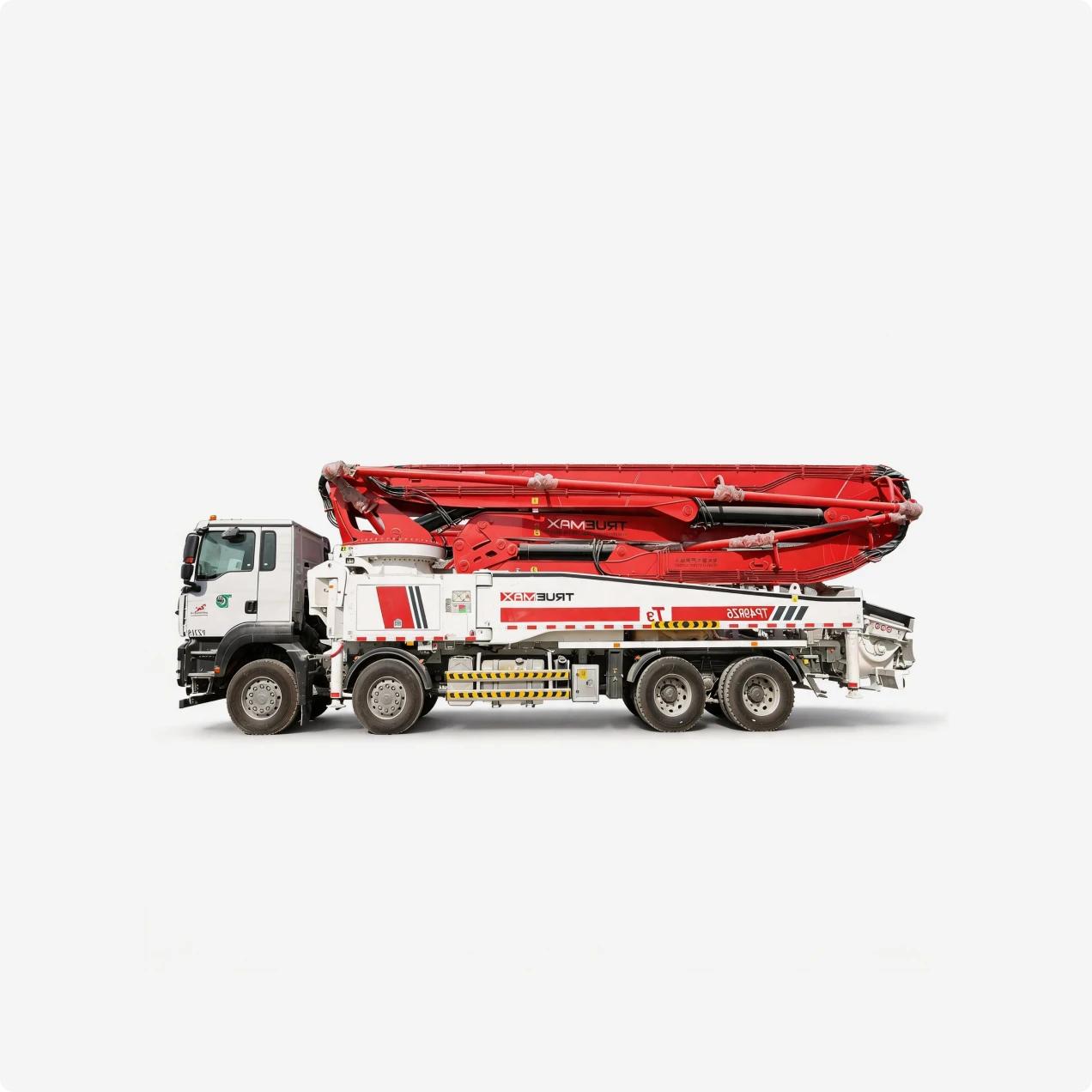
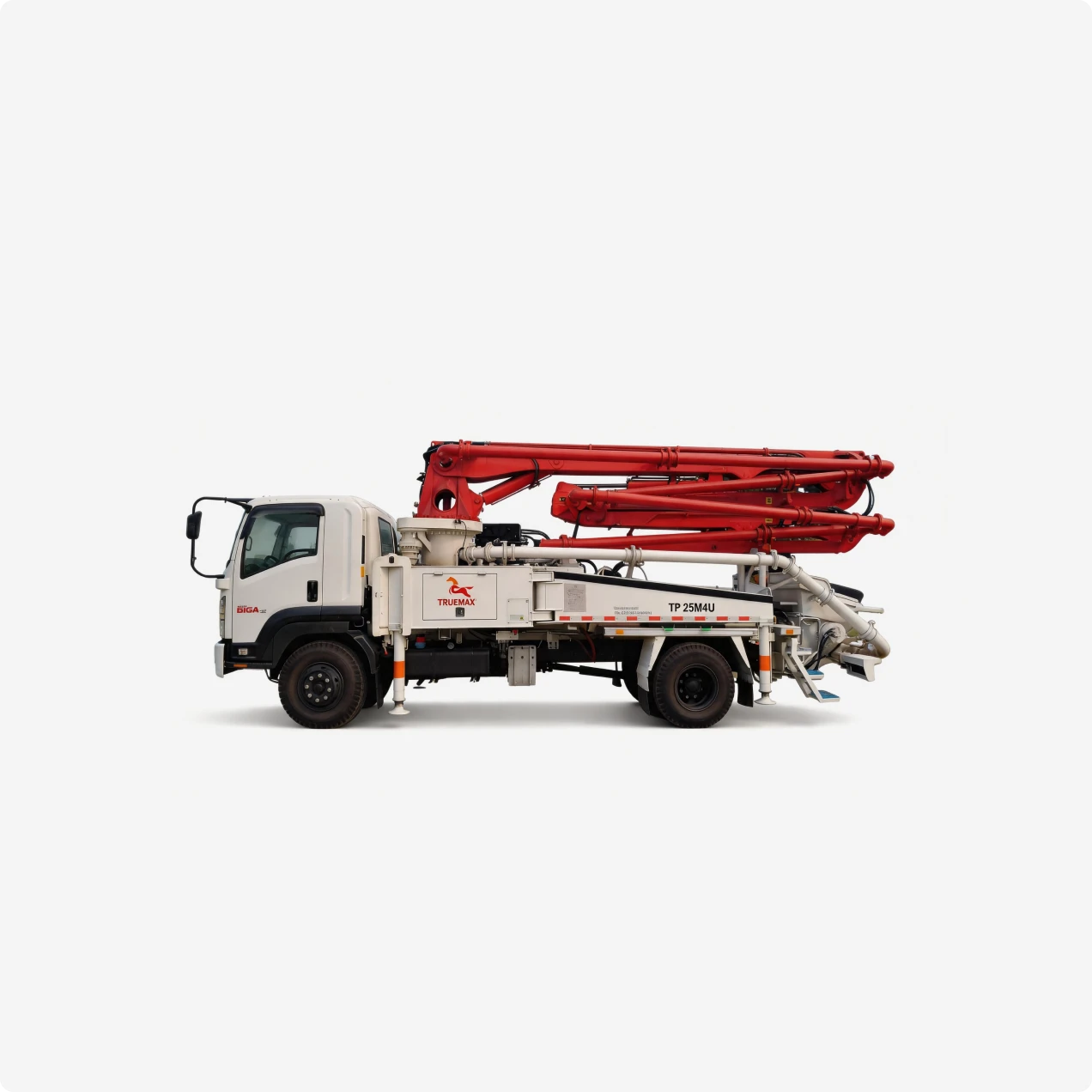
A truck-mounted concrete boom pump is a self-propelled, articulated boom pump used to deliver fresh concrete from a truck mixer (or central hopper) to the point of placement through a closed pipeline running along the boom arms. The pump itself is a twin-cylinder hydraulic piston pump fitted with an S-tube switching valve at the hopper end. The two pumping cylinders work in 180° opposition: while one cylinder draws concrete from the hopper through the suction side of the S-tube, the second cylinder discharges into the delivery pipeline. The S-tube swings between the two cylinders on every stroke, switching the suction and discharge paths.
Concrete pressure is generated by the hydraulic system acting on the back face of each pumping piston. On the TRUEMAX A-series boom pumps, the hydraulic main pressure is 32 MPa, transmitted to the pumping cylinders to produce concrete pressures of 8.3 to 12 MPa at the discharge — enough to deliver concrete vertically through the boom and onward into a placing boom or end hose. Boom positioning is independent of pumping: a separate proportional hydraulic circuit articulates each boom section, with load-sensing flow control for shock-free movement under load.
Pumpable Concrete: Mix Design Parameters
The pump can only deliver what the mix design allows. ACI 304.2R-17 (Guide to Placing Concrete by Pumping Methods) is the authoritative reference. Pumpability depends on six interrelated parameters:
• Water-binder ratio: 0.30–0.50 typical, 0.30–0.40 for high-strength and high-rise vertical pumping. Lower ratios need more lubrication from cement paste and SCMs.
• Slump / consistency: 100–180 mm (4–7 in) for conventional pumped concrete; up to 210 mm or self-consolidating concrete (SCC) for difficult placements. Slump retention through pumping time must be considered for long pours.
• Cement / binder content: 320–450 kg/m³ typical, depending on strength class. Excess cement is uneconomical and does not improve pumpability on its own.
• Supplementary cementitious materials (SCM): Fly ash (Class F) replacing 15–25% of cement improves pumpability and reduces line friction. Ground granulated blast-furnace slag (GGBS) at 30–50% replacement is common in high-rise and durability-driven mixes.
• Coarse aggregate grading: ASTM C33 / C33M compliance is required. Maximum aggregate size ≤ 1/3 the smallest inside pipe diameter (typically 25 mm for 125 mm pipe, 32 mm for 150 mm pipe). Continuous grading minimises friction loss.
• Fines content: Sand fraction passing 300 µm at 15–20% of total aggregate, passing 150 µm at 5–8%. Insufficient fines causes bleed-water separation and pipeline blockage at bends.
Admixture selection: water-reducing admixtures (mid-range or high-range) improve workability without adding mix water; air-entraining agents at 4–7% are routine in freeze-thaw climates but reduce strength predictably. Polycarboxylate ether superplasticisers (PCE) are the standard for high-rise and SCC pumping.
Mixes that fail pumpability assessment — typically due to inadequate fines, oversized aggregate, low cement, or excessive fibre dosage — should not be specified for pumped placement. ACI 304.2R recommends trial-pumping of marginal mixes before structural pours.
Pump-to-Pipeline Matching
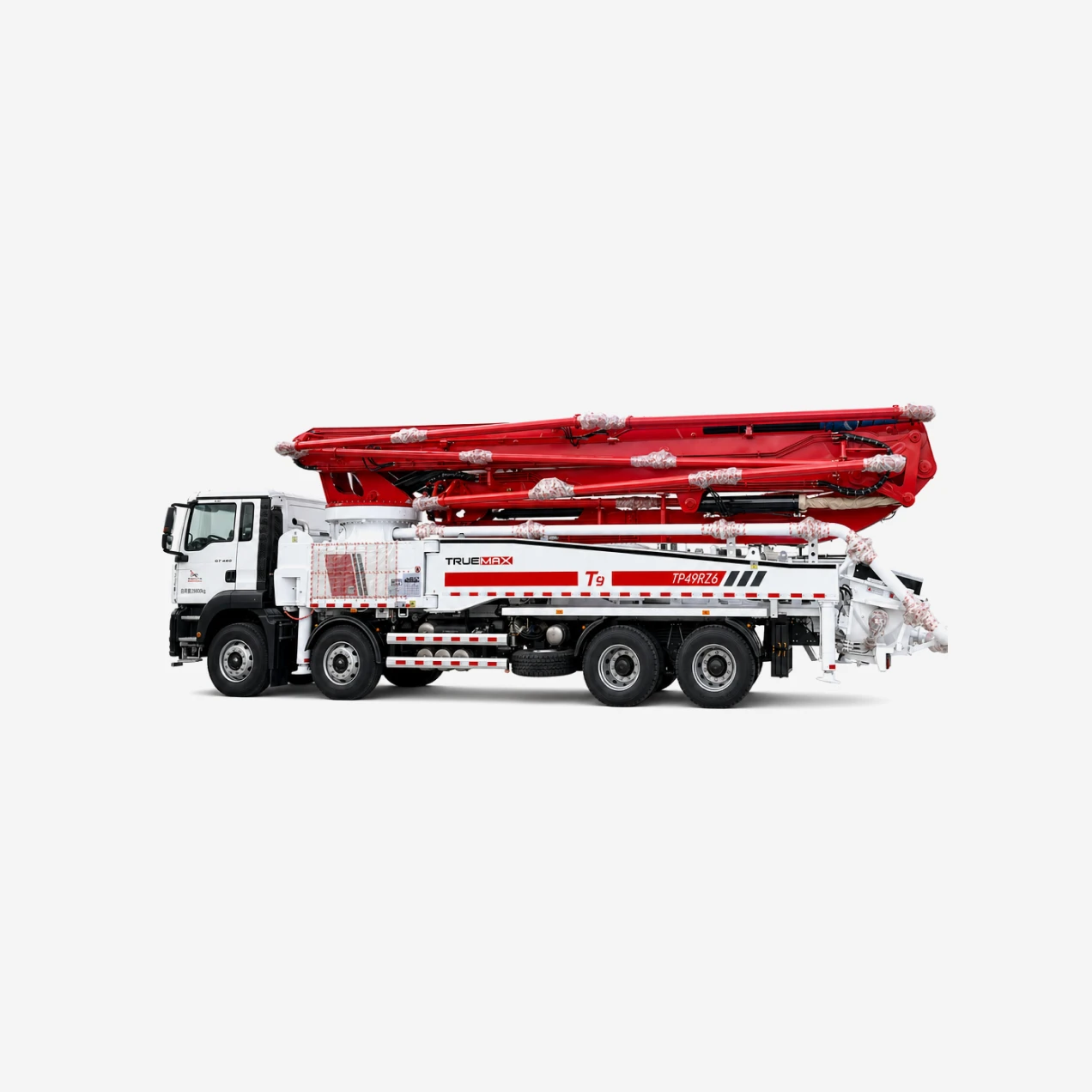
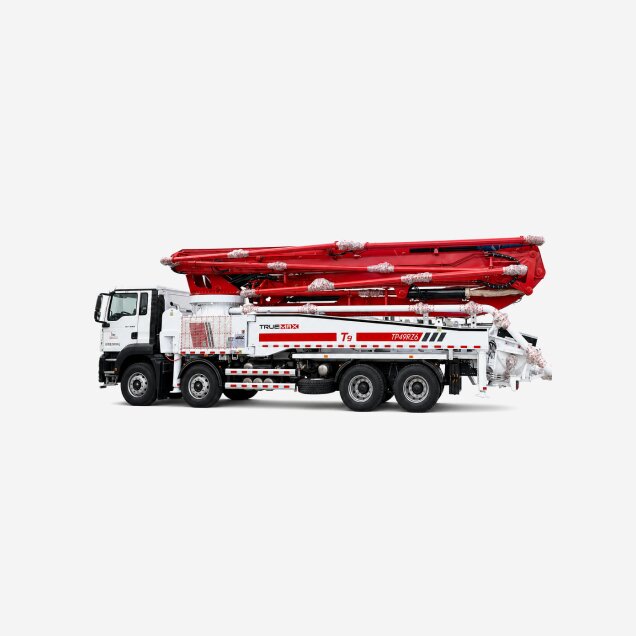
Pipeline sizing and routing determine the pressure budget available at the point of discharge. The pump's nameplate pressure (e.g. 12 MPa peak on a TP49RZ6) is the upstream value; losses through the pipeline reduce the effective discharge pressure.
Typical pressure losses (125 mm steel pipe, conventional mix)
• Vertical rise: ~1 bar (0.1 MPa) per 4–5 m of lift
• Horizontal run: ~0.5–1.0 bar (0.05–0.1 MPa) per 100 m
• Each 90° bend: ~1–2 bar equivalent additional loss
• Reducers and flexible hose: ~2–3 bar combined
A truck-mounted boom pump rated for 12 MPa (120 bar) discharge pressure delivers approximately 60 m vertical reach through the boom in addition to its mechanical extension — which is why the TP63RZ6 (62.5 m vertical) does not require a riser pipe to reach its full extension. Beyond the boom range, stationary high-pressure pumps (e.g. SP100.23.360D at 23 MPa) are used to drive concrete into building-mounted riser pipework feeding a placing boom on the working storey.
Pipeline material and accessories
TRUEMAX boom delivery pipes use hardened seamless steel pipe with double-layer construction at high-wear bends. Standard configuration is 125 mm internal diameter (some markets specify 150 mm). Pipe couplings are quick-release clamp type to EN-equivalent specification, with hardened wear sleeves at every bend. Flexible end hose at the boom tip is wire-reinforced rubber rated to the pump's working pressure.