
Pick the wrong concrete pump and the rest of the project pays for it — slower pour rates, more labour, hoses in places they shouldn't be. Pick the right one and a 200 m³ slab goes down in an afternoon with three people on site.
There are three main pump types you'll see on a B2B equipment list: truck-mounted boom pumps, truck-mounted line pumps, and stationary (trailer-mounted) pumps. Each one solves a different problem. This guide walks through what each pump does, where it earns its place, and how to pick by application — written by someone who's been specifying these pumps for fifteen years.
The Three Pump Types in One Table
| Type | What It Is | Best For | TRUEMAX Range |
| Truck-Mounted Boom Pump | Truck-chassis pump with an articulating boom (25-63 m reach) for precision concrete placement | Mid-rise buildings (up to 60 m), bridges with abutment access, large slabs, fast set-up jobs | TP25M4, TP38RZ5, TP43RZ5, TP49RZ6, TP56RZ6, TP63RZ6 |
| Truck-Mounted Line Pump | Truck-chassis pump that pushes concrete through a steel pipeline — no boom | Long horizontal runs, bridge decks, projects too far from pump for boom reach | LP100.18.253D (18 MPa), LP100.23.360D (23 MPa) |
| Stationary (Trailer) Pump | Trailer- or skid-mounted pump for fixed-position high-pressure work, fed by riser pipeline | High-rise buildings (above 60 m), continuous high-volume pours, fixed plant locations | A9 series: SP50.10.82D, SP90.18.253D, SP100.23.360D |
These aren't interchangeable. Each pump is built for what it does — putting a boom pump where a stationary pump is needed costs you time and reach; putting a stationary pump where a boom pump fits creates unnecessary cost and rigging.
Truck-Mounted Boom Pumps — Speed and Precision
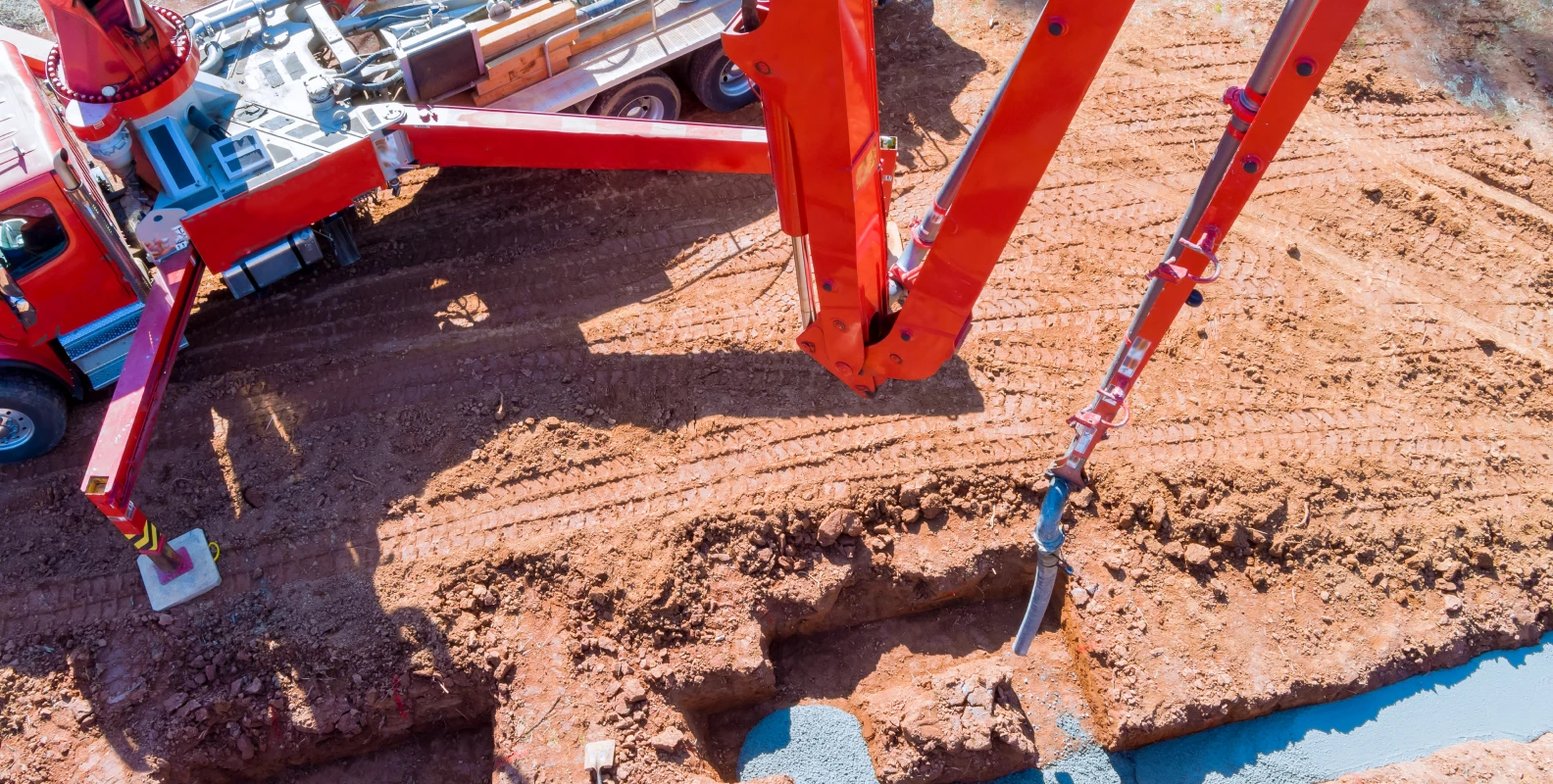
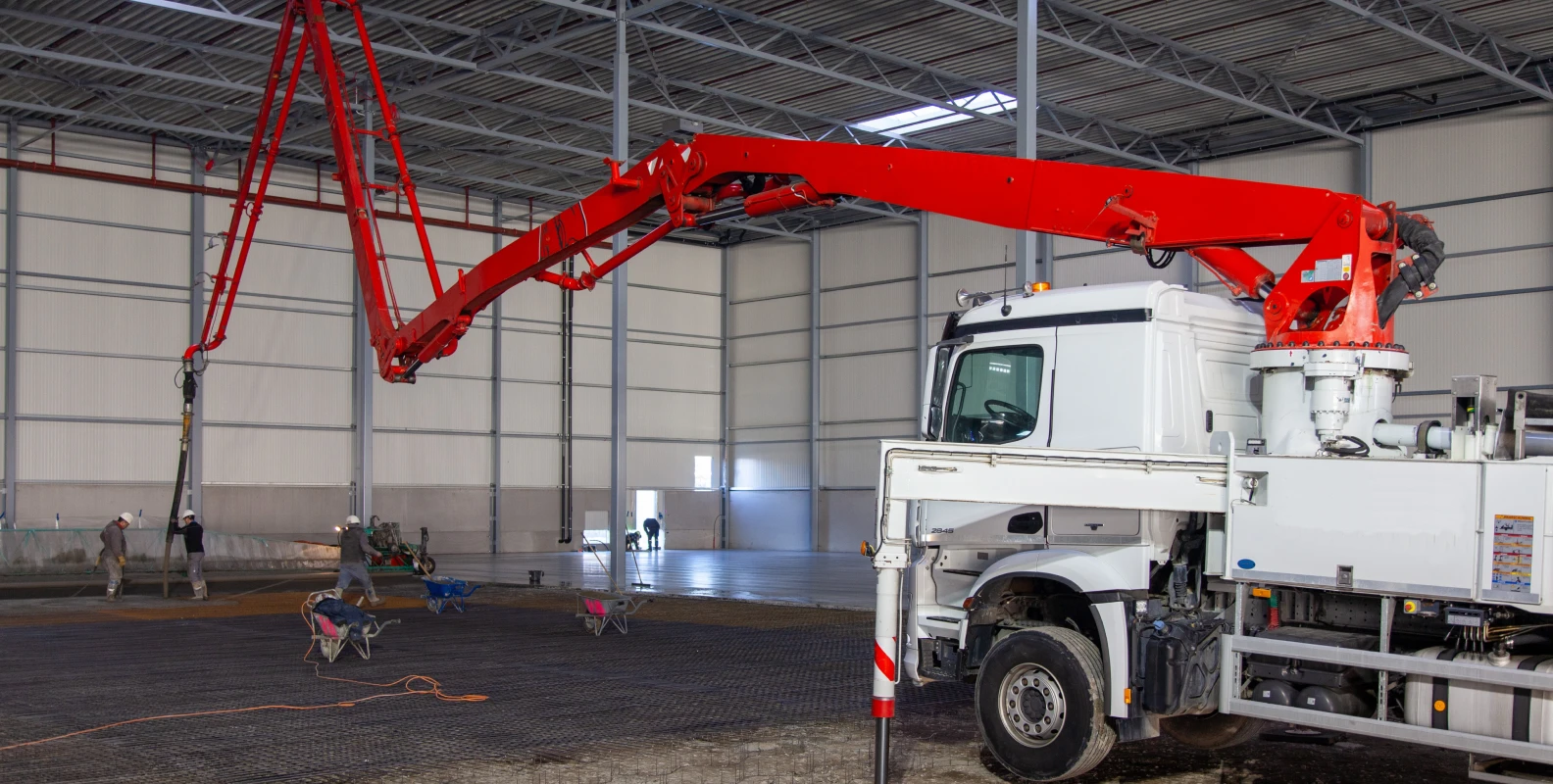
The boom pump is the workhorse of commercial construction. A truck chassis carries the pump unit and a folding boom that unfolds to 25-63 metres of reach. The operator runs the boom by remote control to put concrete exactly where it's needed — over walls, into columns, across a slab — without dragging hose around the site.
When a boom pump is the right pick
• Buildings up to about 60 m tall (boom pump vertical reach typically tops out around 60 m on the largest models)
• Bridge work where the pump can park at the abutment or close to the work
• Large floor slabs where the boom covers the pour from one set-up
• Sites where set-up time matters — a boom pump is operating within 10-15 minutes of arrival
• Sites with congestion or obstacles where the boom has to reach over equipment, formwork or material
What we actually see in the field
Most commercial high-rise pours below 50 m use a boom pump from a vendor on a per-day rate. Above 50 m, the boom pump still earns its place for podium and ground-floor pours, even when a stationary pump is also on site for the tower itself. A 49-56 m TRUEMAX TP49RZ6 or TP56RZ6 handles 95% of the building work most contractors see. The 63 m TP63RZ6 starts becoming the right pick when the building footprint exceeds about 40 m square and the pump has to reach to the far corner from one position.
Truck-Mounted Line Pumps — Long Horizontal Reach
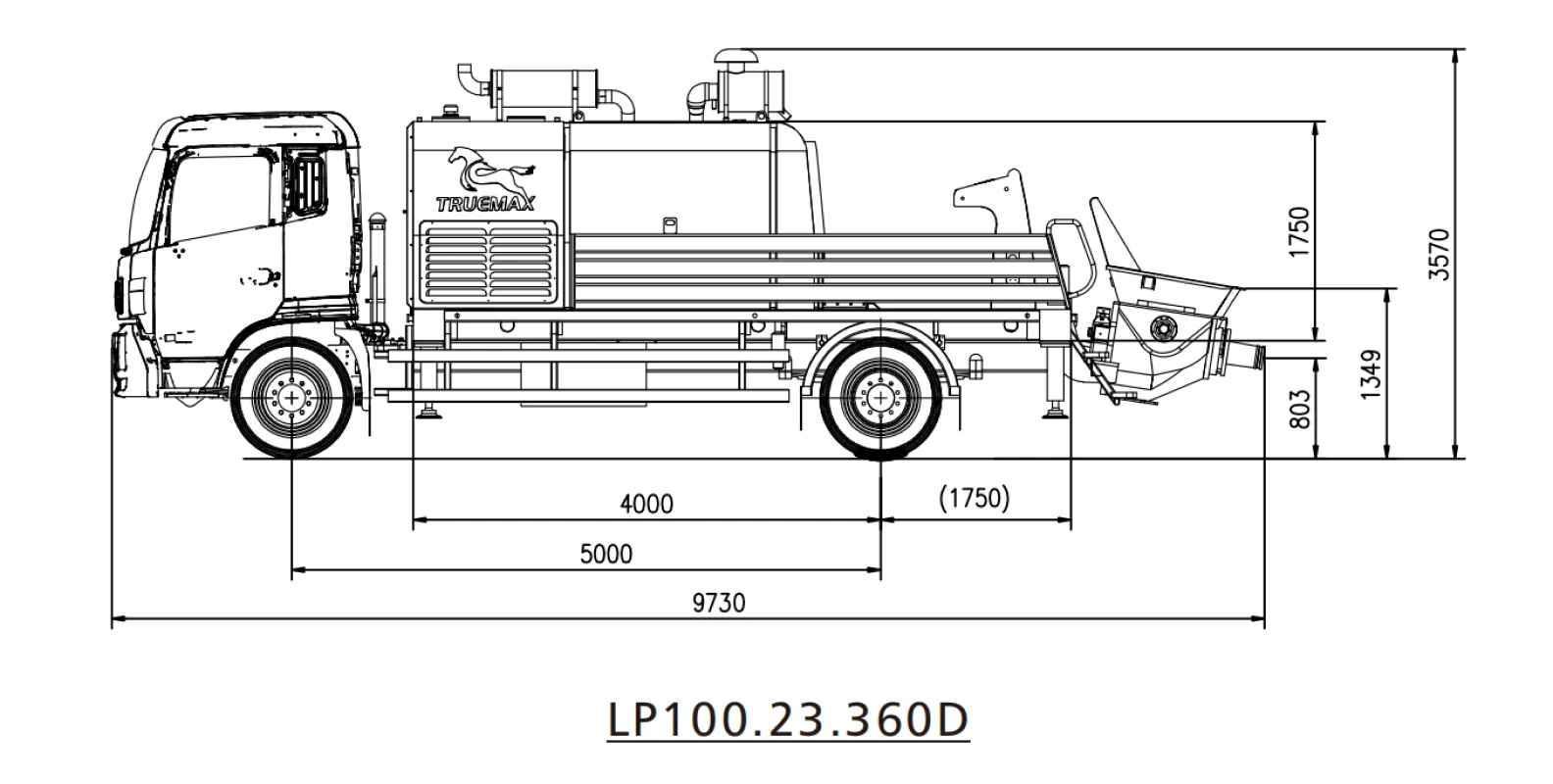
The line pump looks like a boom pump without the boom. A truck-mounted pump unit pumps concrete through a steel pipeline laid along the ground or up a building riser, instead of through a boom. The end of the pipeline gets a flexible rubber hose for the last few metres to the pour.
When a line pump beats a boom pump
• The pour is more than 60 m horizontal from where the pump can park
• Long bridge decks where the pump can sit at one abutment and the line runs along the deck
• Tunnel concreting where pipe runs along the tunnel and the pump stays at the portal
• Restricted urban sites where a boom pump's outrigger footprint doesn't fit but a smaller line-pump truck does
• High-rise pours where the line pump pushes concrete up a riser pipe to a placing boom on the working floor
The TRUEMAX LP100.18.253D and LP100.23.360D are the two line pumps we offer. The 18 MPa unit handles routine line pumping out to 200 m horizontal or so; the 23 MPa unit pushes further (~300 m horizontal at typical mix) and is also the right pick where the line includes vertical sections — e.g., line pump feeding a riser to a placing boom on an upper floor.
What you give up vs a boom pump
Labour. Running pipework along the ground, anchoring it, cleaning it at the end of the day, and breaking it down between pours is all manual work. A boom pump does the same delivery with one operator on the remote control and no pipe handling. So line pumps win on reach, boom pumps win on labour cost. The break-even on a project where both could work is usually around the 50-60 m mark — beyond that, the line pump's reach advantage wins; below that, the boom pump's labour advantage wins.
Stationary Pumps — High Pressure for High-Rise and Continuous Pours
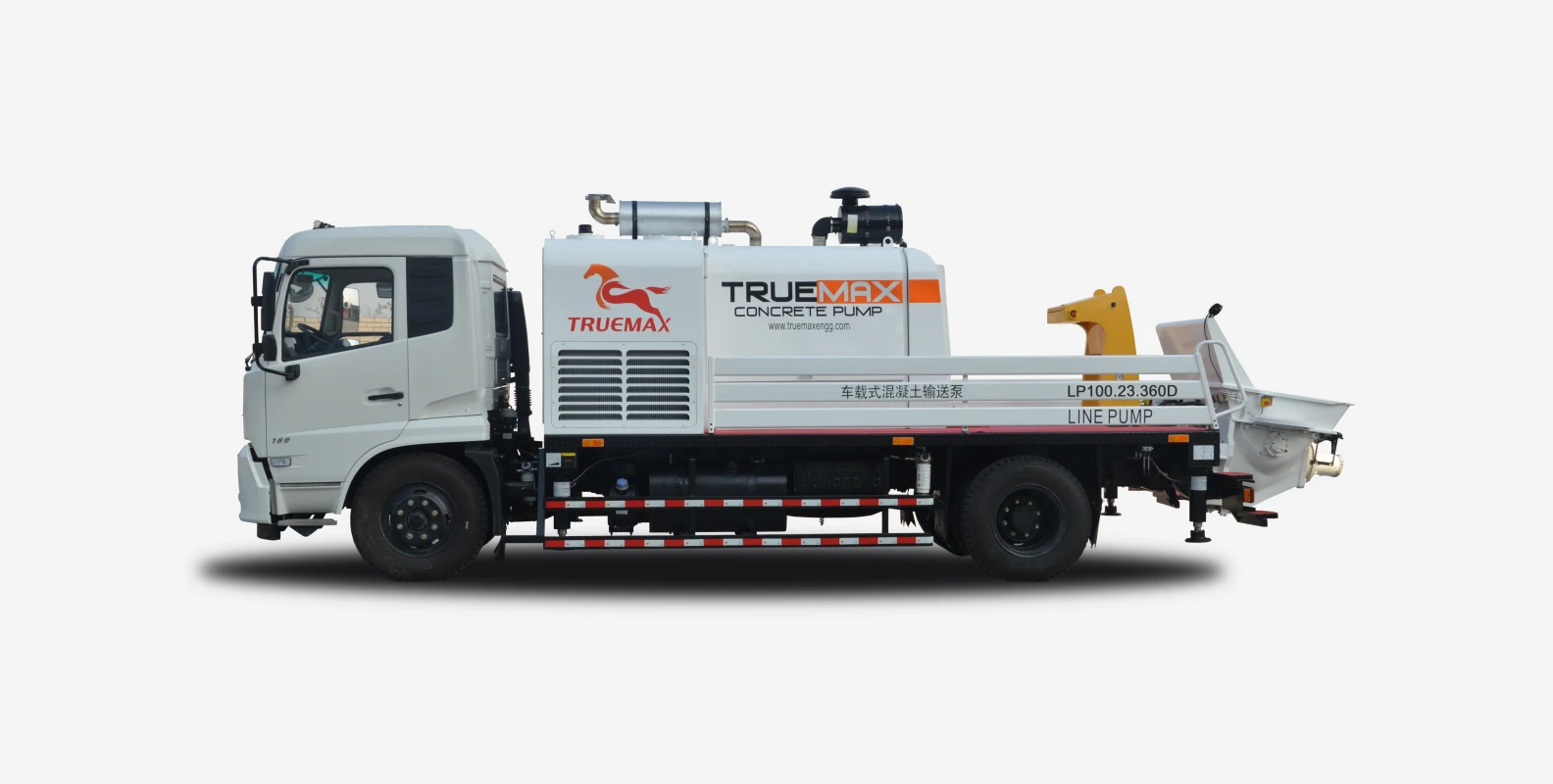
The stationary pump (sometimes called trailer pump or static pump) is a heavy-duty pump unit on a skid or trailer, designed to sit in one place and run for the duration of a project. No boom, no truck — just the pump and its diesel or electric drive.
Where the stationary pump is the only real option
• Buildings taller than 60 m — beyond truck-mounted boom pump reach
• Long continuous pours that run for 12+ hours at high volume
• Sites with no access for a truck-mounted unit (constrained urban plots, underground works, offshore)
• Projects that need 100% uptime over months — a trailer pump set up correctly is the most reliable concrete pump configuration
The TRUEMAX A9 series stationary pumps span the duty range:
• SP50.10.82D — 50 m³/h at 10 MPa, for small commercial high-rise and continuous-supply needs
• SP90.18.253D — 90 m³/h at 18 MPa, the workhorse mid-band stationary pump for buildings up to ~250 m vertical
• SP100.23.360D — 100 m³/h at 23 MPa, for super-tall high-rise and ultra-long-distance pumping (the spec deployed on Katara Tower)
What 'high pressure' actually means
Pressure rating is what determines how high or how far the pump can deliver concrete, not output. Concrete in a vertical pipe loses about 1 bar of pressure for every 5 metres of lift (the exact figure depends on mix and pipe diameter, but that's the rule of thumb). A 23 MPa pump = 230 bar = roughly 350-400 m of vertical reach with a typical mix. A 10 MPa pump = 100 bar = roughly 150-180 m. Choose the pressure spec for the height; choose the output for the rate.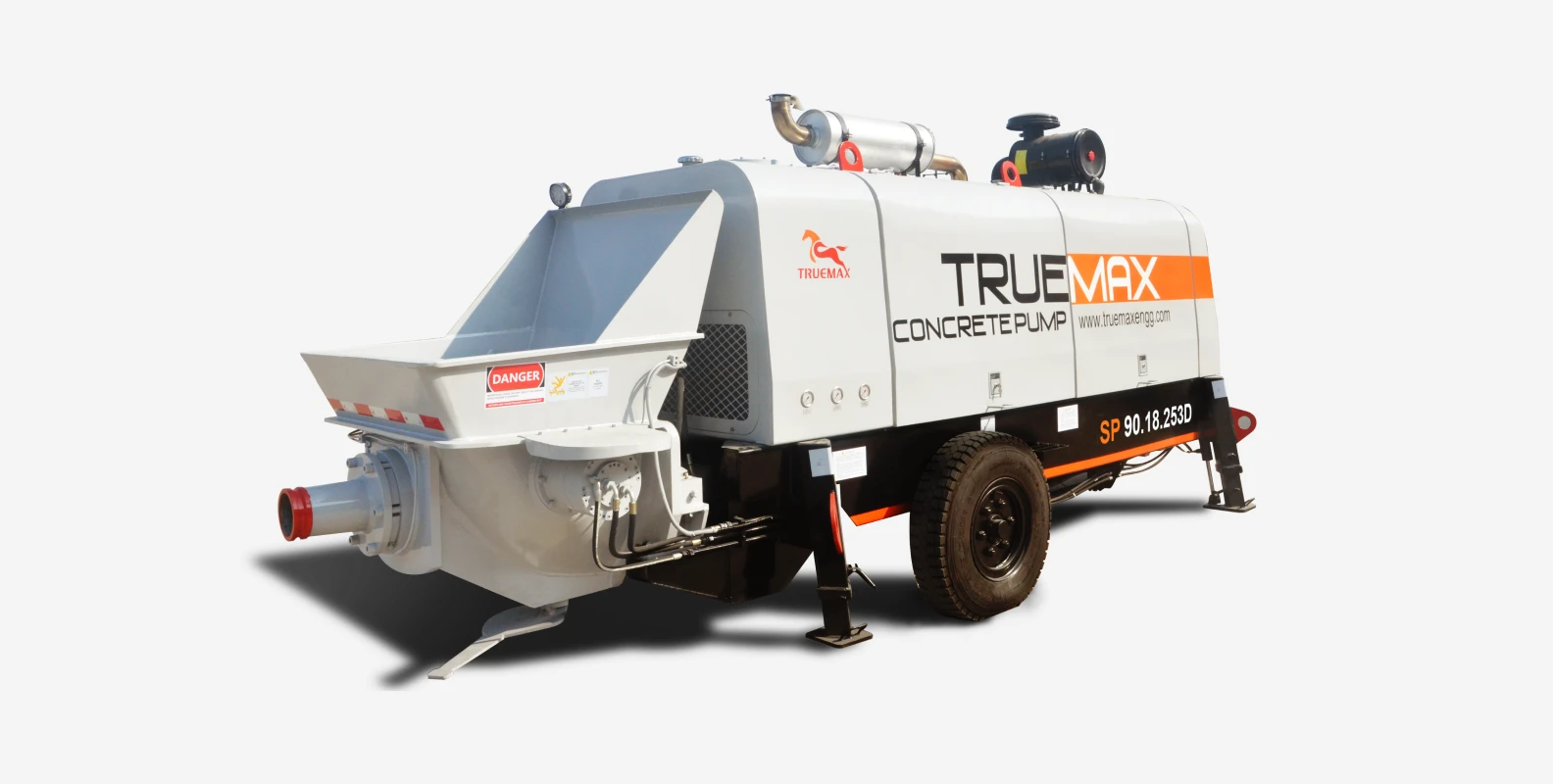
Pump Selection Decision Tree
A practical sequence to work through:
1. How tall is the pour? Under 60 m → boom pump (probably). Over 60 m → stationary pump.
2. Does a truck need to drive to the pour location? If yes → boom pump or line pump. If no (fixed site, plant operation, underground) → stationary pump.
3. How long is the horizontal distance from where the pump can park to the pour? Under 30 m → boom pump. 30-100 m → boom pump with long reach (TP56/TP63) or line pump. Over 100 m → line pump.
4. Is it a one-day job or a multi-month project? One-day → typically rented boom pump. Multi-month → owned or long-term-leased stationary pump pays back better.
5. What's the sustained pour rate? Under 60 m³/h sustained → smaller boom or line pump (TP38 / LP100.18). 60-100 m³/h → larger boom or stationary (TP56 / SP90). Over 100 m³/h sustained → SP100 stationary pump.
Frequently Asked Questions
Can a line pump handle vertical pumping like a stationary pump?
Yes, up to a point. Truck-mounted line pumps with high pressure (TRUEMAX LP100.23.360D at 23 MPa) can drive concrete up a vertical riser to perhaps 250-300 m vertical reach. But the truck has to stay parked for the duration of the pour, which uses up a chassis that could be doing other work. For pure vertical high-rise applications above 100 m, a stationary pump fixed on site is usually the better economic answer.
How much concrete can a boom pump pour per hour?
Theoretical output of a typical large boom pump is 150-180 m³/h. Actual sustained output is usually 60-80 m³/h once you account for truck-mixer arrival time, pipe cleaning between pours and operator breaks. Plan capacity at the actual figure, not the nameplate.
What's the price difference between the pump types?
Approximate price ranges (export, FOB China, indicative): truck-mounted boom pumps run $200,000-$700,000 depending on boom length and chassis spec. Truck-mounted line pumps run $80,000-$250,000. Stationary pumps run $40,000-$180,000 for the pump unit alone (excluding pipeline and any high-rise rigging). Final pricing depends on configuration, emission spec, customisation and shipping destination — we'll quote your exact project.
Do I need to buy the pump or can I rent one?
For one-off jobs of any pump type, renting from a local concrete-pumping contractor is usually more economical than owning. Renting becomes less economical above about 80-100 days of use per year. Most TRUEMAX buyers are concrete-pumping contractors who own the pumps and rent them out, plus large construction firms with high enough year-round pump utilisation to justify ownership, plus precast/RMC operators with a permanent site need.
What's the difference between an S-valve pump and a rock-valve pump?
Both are designs for the valve that switches concrete flow between the pump's two pistons. S-valve pumps (used on most TRUEMAX models) handle higher pressure and tighter concrete (smaller slump) — preferred for high-rise and structural concrete. Rock-valve pumps tolerate larger aggregate but lower pressure — preferred for mass-concrete and large-aggregate mixes like dam concrete. For 95% of commercial and infrastructure applications, S-valve is the right pick. Our A9 series uses high-pressure S-valve geometry across the range.
Can a concrete pump handle wet-shotcrete and other mixes?
Standard concrete pumps handle conventional ready-mix concrete (slump 100-200 mm). Wet-shotcrete needs a dedicated shotcrete pump with shotcrete-specific valve geometry and nozzle equipment. Grout, mortar and self-consolidating concrete (SCC) work with regular concrete pumps with appropriate hose/pipe sizing. We can configure the pump for non-standard mixes on request — tell us the spec on enquiry.
-

TrueMax
Concrete & Construction Equipment ManufacturerEstablished in 2003, Truemax designs, manufactures, and delivers concrete pumping equipment, crushing machinery, and construction hoisting systems from our own factory in Haining, China to jobsites in over 120 countries.


