

Concrete that has to climb 200 metres faces a problem that ground-pour concrete never sees: pressure. The taller the structure, the harder the pump works, and a single weak link — a worn pipe bend, a mismatched pump-to-boom pairing, an undersized batching feed — can stop a high-rise pour at the worst possible moment. Building on tall structures asks more of the equipment than capacity figures suggest.
Our equipment has handled high-rise pours on FIFA 2022 Lusail Stadium, Katara Tower Qatar, Dubai Expo 2020 and dozens of city-scale builds across the Middle East, Africa and Southeast Asia. This page walks through what makes the high-rise pumping package different from a typical commercial set-up, what to specify for a build of your height and footprint, and where TRUEMAX's range fits.
What Counts as 'High-Rise' Pumping
There is no single height that separates a normal pour from a high-rise one — the threshold is what your pump can sustain. Most truck-mounted boom pumps top out around 60-65 m vertical reach at full extension. Stationary high-pressure pumps push concrete much further: TRUEMAX's SP100.23.360D runs at 23 MPa system pressure, enough to lift a 1:4 mix to roughly 400 m vertically through a 125 mm steel pipe, which is the practical ceiling for current pump-only systems. Beyond that, the engineering goes from buying a pump to designing a vertical concrete logistics system.
Three things separate high-rise pumping from regular truck-mounted pump work:
• Sustained high pressure, not peak figures. A pump rated at 23 MPa peak is not the same as one that runs at 23 MPa all day. High-rise duty asks for the second.
• Vertical pipeline anchored to the structure. The riser pipe is welded or bolted into the building's slab edge, with hardened steel bends and concrete-grade clamps every two storeys.
• A placing boom at the top, not just a hose. Above 100 m the operator can't drag end-hose around the working floor — a placing boom on the working storey is how the concrete actually reaches the column or wall.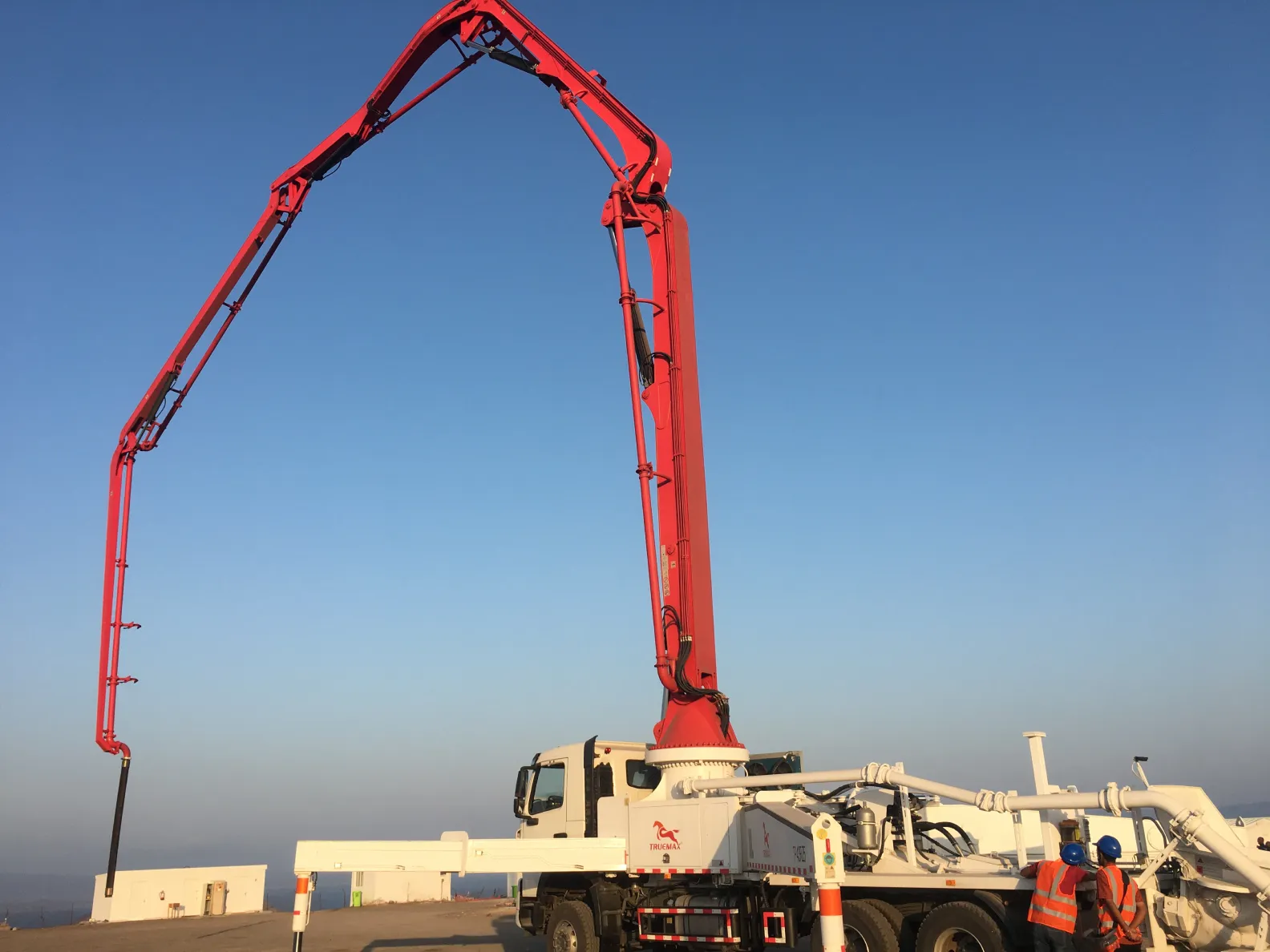
The TRUEMAX High-Rise Equipment Package
Our high-rise pours are built from four pieces working together. Each piece is a real product line, not a configuration option:
| Equipment | Role | TRUEMAX Range |
| Stationary high-pressure pump | Generates the pressure to lift concrete vertically through the riser pipe | SP50.10.82D (10 MPa, 50 m³/h) to SP100.23.360D (23 MPa, 100 m³/h) |
| Column-climbing or lattice tower placing boom | Distributes concrete across the working floor; climbs with the building | PB28A 27.7 m climbing, PB35A 35 m climbing (16.2 m free-standing), PB51AT 51 m lattice tower |
| Concrete batching plant | Produces ready-mix at the rate the pour needs | CBP60S 60 m³/h up to CBP240S 240 m³/h |
| Concrete truck mixers | Shuttle ready-mix from plant to pump hopper | CTM6 to CTM14, paired with SINOTRUK or HOWO N7 chassis |
1. Pump selection — pressure first, then output
On a 50-storey build the question is not 'how many cubic metres per hour' before 'how many bar at the discharge side'. A 60 m³/h pump at 10 MPa cannot reach the 35th floor; a 50 m³/h pump at 23 MPa can. Once the pressure clears the height, then output matters.
TRUEMAX builds the A9 series of stationary pumps specifically for this. The SP100.23.360D delivers 23 MPa concrete pressure with a 100 m³/h theoretical output — the size and specification used on Katara Tower in Qatar. For builds under roughly 200 m a smaller A9 unit (SP90.18.253D, 18 MPa) is usually the right pick; for builds beyond 300 m the SP100.23.360D is what we recommend by default.
2. Placing boom — column-climbing or free-standing
Above 5-6 storeys, end-hose work on the floor becomes the bottleneck. A column-climbing placing boom on the working storey is how the pour rate stays high. TRUEMAX builds a five-model B8 family in this category — from the 27.7 m PB28A-3R-II up to the 35 m PB35A, the largest in the column-climbing line, with a 16.2 m free-standing height and 22 kW power unit.
Column-climbing booms ride a mast that's anchored to the building's structural columns. Each climb cycle takes 30-60 minutes and is usually programmed to follow the building's typical-floor cycle. For builds where the structure can't carry climbing loads, the lattice tower booms (PB38BT-4R-E at 38 m, PB51AT-4R-E at 51 m) stand free on their own foundation up to 40-46 m, with greater independence from the building geometry.
3. Batching plant — sized to the pour rate, not the pump's peak
The plant is sized to keep the pump fed, which means matching its sustained output rather than the pump's nameplate. A pump rated 100 m³/h in practice averages 60-70 m³/h once you allow for cleaning, pipe changes and waiting on truck mixers. So a CBP120S stationary plant (120 m³/h theoretical, JS2000 twin-shaft mixer) is the typical match for a high-rise pump operating at full duty. Higher-volume builds — long continuous mat pours, podiums — step up to CBP180S or CBP240S.
4. Truck mixers — fleet sizing follows haul distance
Each truck mixer is in motion 80% of its day. A 12 m³ CTM12 on a 6×4 SINOTRUK chassis loaded at the plant takes around 10-15 minutes to fill, drives to the pump, discharges and returns. On a typical urban high-rise we plan one mixer for every 6-8 m³/h of sustained pump throughput, which means a 70 m³/h pump needs 9-12 trucks rotating to keep the hopper fed. Under-sizing the fleet here is the most common cause of high-rise pumping delays we see in the field.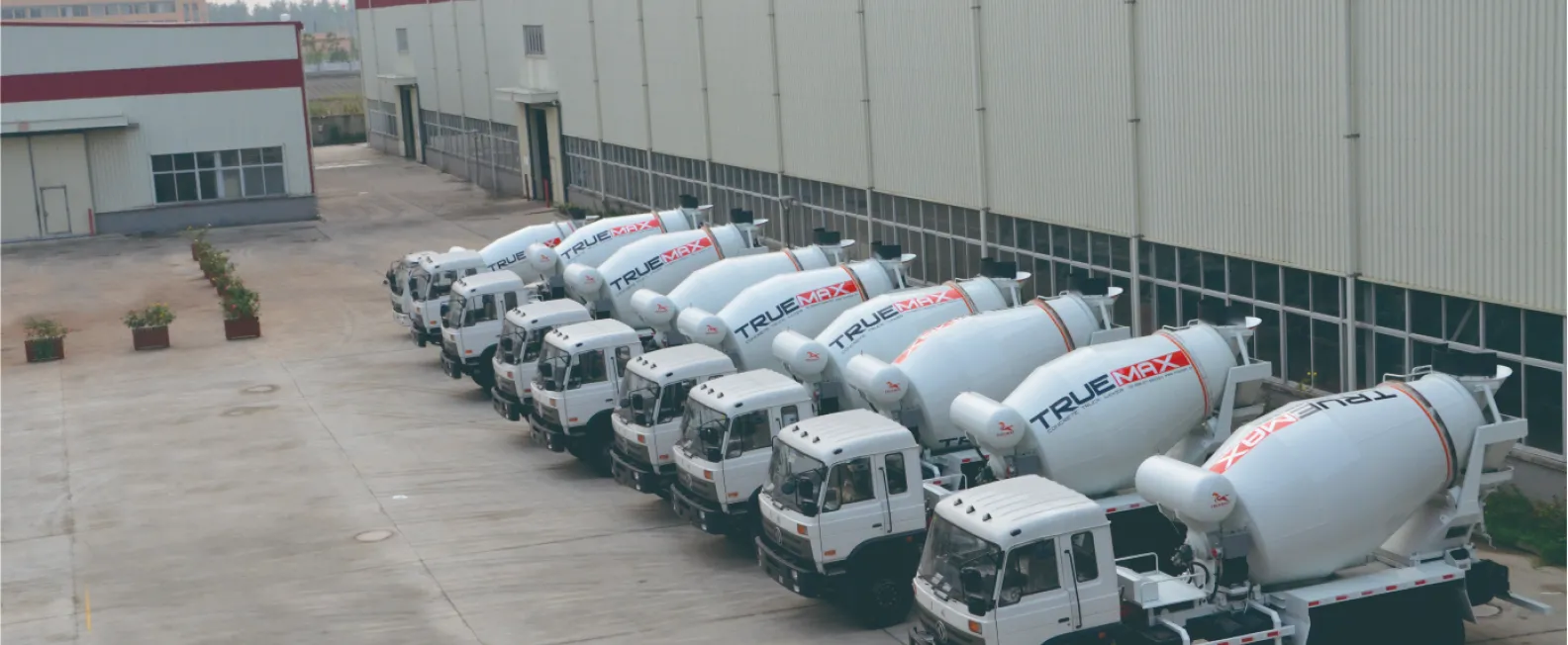
Proven Where High-Rise Pumping Is Hardest
TRUEMAX equipment has delivered concrete on some of the most demanding high-rise projects of the last decade:
• FIFA 2022 Lusail Stadium (Qatar) — concrete pumping for the bowl roof structure and supporting concrete elements
• Katara Tower (Qatar) — vertical pumping with high-pressure stationary pumps and column-climbing placing booms
• Dubai Expo 2020 stormwater tunnel — high-volume continuous concrete delivery
• Qatar Rail Metro Project (Doha) — over 60 sets of heavy equipment and 7,000 tons of tunnel steel structures, meeting both UK and Qatar standards
• Hundreds of commercial and residential high-rises across the Middle East, Africa and Southeast Asia
Each project asked us to do more than ship a pump. We sized the riser-pipe layout, planned the placing-boom climb cycle, and stayed on site through commissioning. That's the work the homepage line 'one supplier, one service team, one responsibility' actually refers to.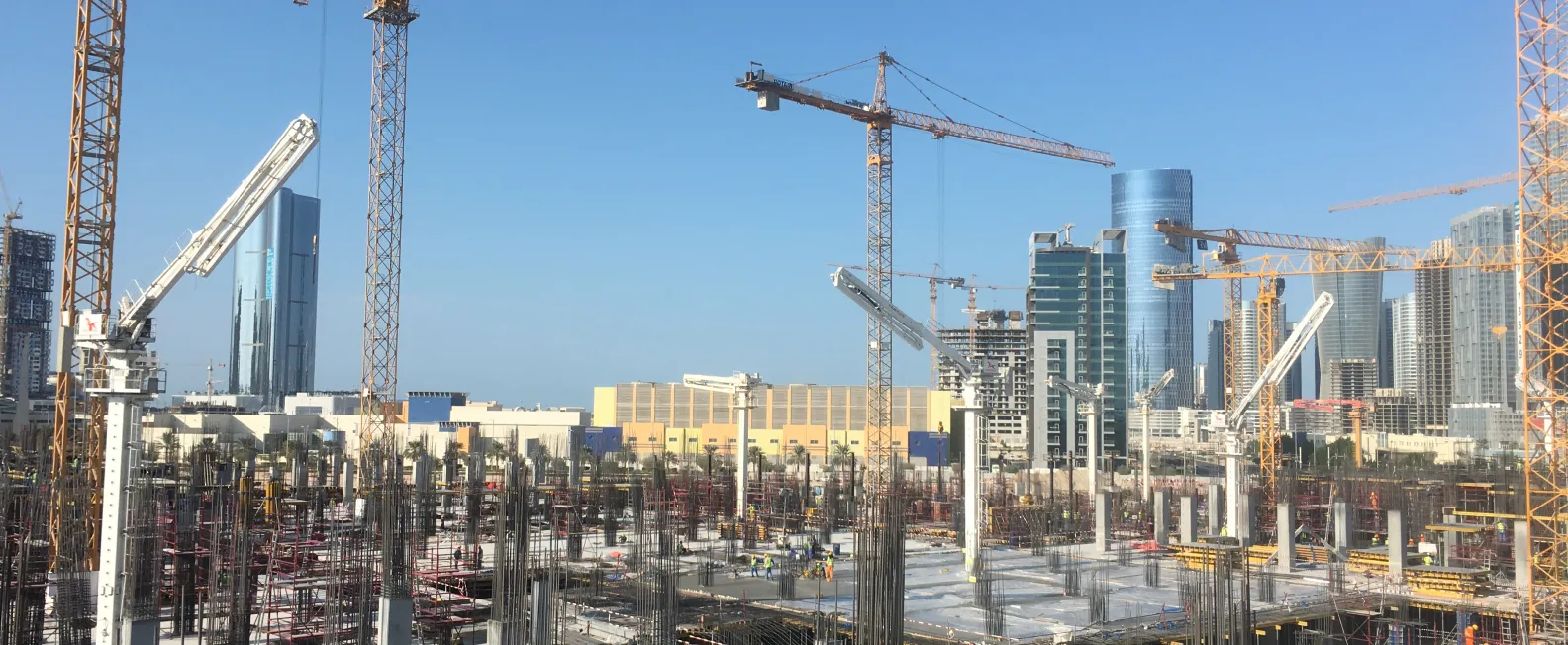
When You Specify a High-Rise Concrete Equipment Package
Send us four things and we can quote a complete package within a working week:
1. Building height, footprint and structural plan
2. Target pour rate (m³/h) — typically the slab cycle from your programme
3. Concrete spec (mix design, strength class, slump)
4. Site access and crane availability for pump and boom installation
We respond within 24 hours on initial enquiries and within three minutes on existing-customer service queries. Equipment goes out with on-site installation, operator training and a remote intelligent monitoring system so problems can be diagnosed without flying engineers to site.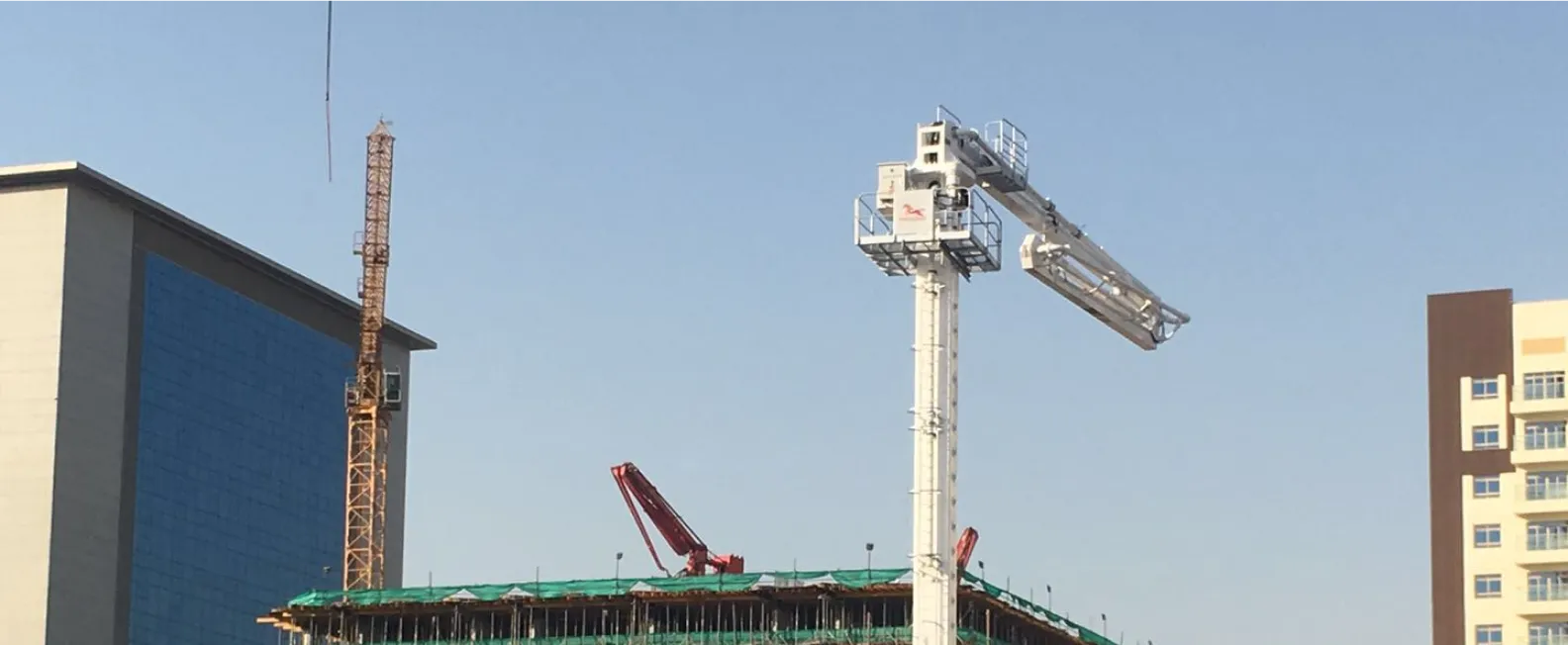
Frequently Asked Questions
How high can a concrete pump actually pump?
The practical ceiling for current single-pump systems is around 400-600 m, depending on mix design, pipe diameter and pump pressure. TRUEMAX's SP100.23.360D runs at 23 MPa, which gives roughly 350-400 m vertical reach on a 125 mm steel pipeline with a typical pumpable mix. Beyond 600 m, projects step up to two-stage pumping — concrete is pumped to an intermediate hopper, then re-pumped to the top.
Boom pump or stationary pump — which is right for a high-rise?
Both, used together. The truck-mounted boom pump handles concrete delivery up to about 60 m — enough for the lower floors. Above that, you switch to a stationary high-pressure pump driving concrete up a riser pipe to a placing boom on the working storey. Most large high-rise pours use a stationary pump from day one because moving the truck-mounted boom pump in and out of a constrained city plot is more expensive than running the riser.
Why does a high-rise project need both a pump and a placing boom?
The pump delivers concrete to the working storey through the riser pipe. The placing boom is what spreads concrete across the floor once it gets there. Without a placing boom, the working crew is dragging end-hose 30 metres around columns and walls, which slows pour rate and creates safety problems. A placing boom turns one delivery point into a 28-35 m radius of coverage.
Will the placing boom need to climb the building, or can it stay at ground level?
It climbs. A column-climbing boom (TRUEMAX PB28A through PB35A) is mounted on a vertical mast anchored to the building's columns and steps up by one storey every 30-60 minutes during the typical-floor cycle. Self-climbing keeps the boom permanently at the working storey without needing a tower crane to relocate it. For non-typical structures, the lattice tower booms (PB38BT-4R-E, PB51AT-4R-E) stand free on their own foundation up to 40-46 m and can be tied into the structure for greater heights.
What's the lead time on a high-rise pumping package?
Typically 90-150 days from PO to ready-for-shipment for a complete package (pump + placing boom + batching plant + truck mixers). Lead time depends on configuration: more customisation extends it, but the A9 series pumps and B8 series placing booms are core products we keep in scheduled production. For urgent projects we can priority-schedule individual machines in 45-60 days.
Can the equipment be reused on the next high-rise after this one?
Yes — that's the normal model. Stationary pumps and placing booms have service lives of 10-15+ years across multiple projects. Batching plants often stay on site for the duration of a multi-tower development. Truck mixers move between projects as part of a regular fleet. We design the equipment for full-life multi-project use and provide spare parts inventory through our overseas service offices in Dubai, Saudi Arabia, Nigeria, Indonesia and elsewhere.
-

TrueMax
Concrete & Construction Equipment ManufacturerEstablished in 2003, Truemax designs, manufactures, and delivers concrete pumping equipment, crushing machinery, and construction hoisting systems from our own factory in Haining, China to jobsites in over 120 countries.


